
Weak consumer confidence and persistent macroeconomic uncertainty have weighed on Chinese shares, even as some businesses continue to grow. Stanley Lu from our offshore partner, Orbis, explains how the Orbis SICAV Emerging Markets Equity Fund is identifying opportunities where business fundamentals and share prices appear increasingly disconnected.
Few markets have tested investors’ patience as thoroughly as China’s over the past five years. From its peak in February 2021, the MSCI China Index fell by more than 50% during the next three years. A regulatory crackdown on the country’s technology champions collided with the slow unwind of a decades-long property boom and a normalisation of both domestic and external demand post-COVID. By early 2024, it seemed investors had largely stopped debating the valuations of Chinese stocks and instead were debating whether the market belonged in a portfolio at all.
The market’s pessimism, it turned out, mispriced the recovery as badly as it had mispriced the risk. Beijing’s September 2024 stimulus package helped lift the MSCI China Index almost 20% that year. In 2025, Chinese AI start-up DeepSeek’s release of a low-cost model that rivalled leading US systems triggered a technology-led rally of more than 30%, which came despite tariffs on Chinese imports into the US briefly exceeding 140%.
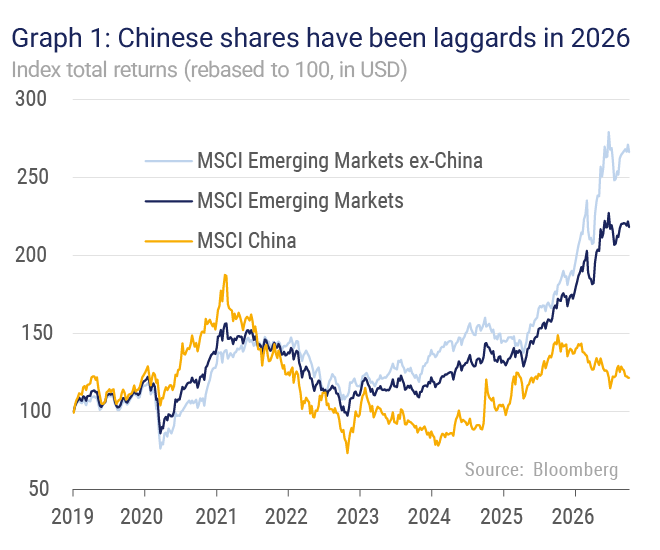
In 2026, the trend has reversed. The Chinese index, dominated by financials, consumer names and internet platforms that sit outside the AI capex cycle, has fallen by close to 12% so far this year. Meanwhile, emerging markets outside China have continued to rally, lifted by earnings upgrades in Korean and Taiwanese technology shares that sit directly in the path of AI infrastructure spending, as shown in Graph 1.
Two longer-running conditions compound investors’ caution on China. The property market, five years into its unwind, continues to weigh on household wealth and sentiment. A deflationary loop adds to this pain: industrial overcapacity has fuelled price wars and squeezed profits, and weaker profits have meant wage cuts and layoffs. Cautious households that have historically saved more than 30% of their income, more than three times the developed-market rate, hold back demand and deepen the overcapacity that started the cycle.
We make no claim to any particular insight into how the macro picture in China might unfold. But when an entire market is punished for macroeconomic uncertainty, while the businesses inside it keep compounding, prices become detached from fundamentals. That gap is exactly what our process is built to exploit.
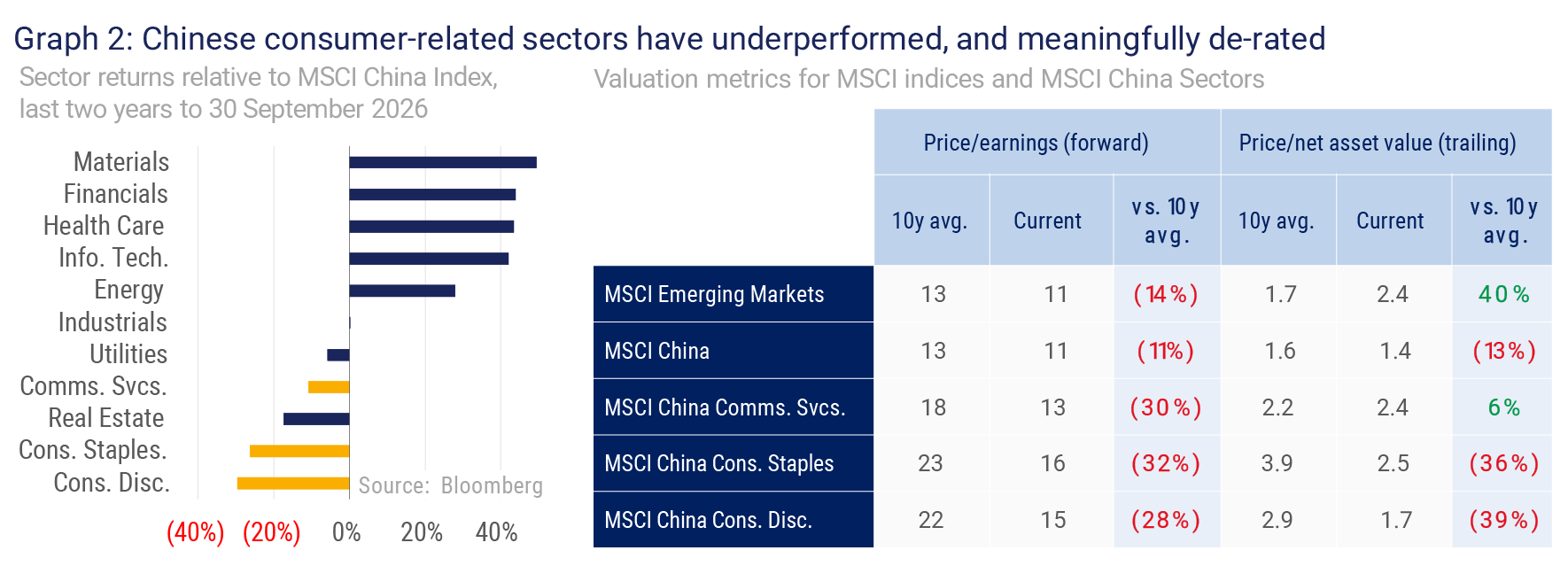
Nowhere is that gap wider than in the parts of the economy closest to the Chinese household. The China Consumer Confidence index – a gauge of consumer sentiment on the economy – has languished well below pre-pandemic levels. Within the MSCI China Index, Consumer Discretionary, Consumer Staples and Communication Services, which includes the internet platforms, have been among the worst-performing sectors this year. The de-rating of stocks within these sectors has been substantial, as shown in Graph 2.
Given our approach, it should come as no surprise that these areas are where we have uncovered some of the most attractive opportunities for the portfolio. PDD Holdings and New Oriental Education & Technology Group, two recent additions, are examples of companies where we believe the market is taking a dim view of the macro headwinds, while underappreciating the fundamental quality of the businesses.
PDD Holdings
PDD Holdings operates Pinduoduo, one of China’s largest e-commerce platforms by items sold. Founded by Colin Huang in 2015, it has since expanded into grocery services domestically, and, through its subsidiary Temu, into overseas e-commerce in around 80 countries with over 200 million weekly active users. All three businesses rest on the same idea: everyday goods cost less when a platform limits product listings and minimises the middlemen and brand mark-ups. This idea is sustained by relentless operational execution and a laser focus on delivering value for customers.
We have followed PDD for a number of years. In late 2024, after management warned that profitability would decline as it spent more to support merchants, the share price fell sharply. We took the opportunity to initiate a position and, through further research, gradually built conviction that the business model is both winning and durable. Pinduoduo gives merchants volume and certainty, which lowers their production costs; lower costs allow lower prices which bring more buyers and orders. This flywheel continues to win market share. In our view, Temu, with the same supply chain, has a real chance of becoming a global franchise.
The founder and his team are long-term oriented, disciplined about returns on investment, and relentlessly focussed on improving the user experience. Importantly, their interests are well aligned with those of minority shareholders. Huang still holds around a quarter of the company’s shares, after donating a 7% stake to fund supplementary compensation for key managers, with the scheme intended to align management incentives with long-term value creation. While Huang has stepped back from day-to-day responsibilities, his commitment to succession is well known, having previously compared entrepreneurs to coral, which dies while the reef it built remains.
Beyond the China macro concerns, much of the cloud that hangs over PDD stems from heavy reinvestment in the platform. About US$15 billion has been committed to support merchants; meanwhile PDD continues to expand overseas at the expense of near-term profit, leading to earnings slipping 13% last year. Management’s tone is consistently conservative; the company discloses little and meets almost no investors, leaving the market with limited understanding of both the model and its long-term potential.
That burden is starting to ease. In August, management described the merchant-support programme as gradually entering a “harvest phase”. We also expect Temu to reach profitability in the foreseeable future. As earnings catch up with the underlying business and the net cash pile worth over half the company’s market value continues to build, we expect sentiment to improve. Better communication from management would speed that up.
At close to 8 times forward earnings, and at below 5 times after-tax operating profit once the net cash pile is deducted, we can own what we believe to be an excellent company, with ample room for growth, at a valuation that more than compensates us for perceived macro risks.
New Oriental
New Oriental serves the same cautious Chinese household, but from a different angle. Pinduoduo helps families spend less. New Oriental provides the service that most refuse to cut: their children’s education.
Founded in 1993, New Oriental is China’s most recognised private education brand spanning pre-college after-school tutoring, overseas test preparation and consulting across more than 1,500 learning centres. A respected educator and entrepreneur, founder Michael Yu remains the largest shareholder with a 12% stake, draws modest pay and has run the company conservatively through several major external shocks over the last 33 years. Each time the company has emerged with higher market share and a broader offering.
Chinese households have historically spent a higher share of their budgets on education than households in many other countries, and in recent years, spending on education has grown faster than household income. A 2025 survey found the share of parents seeking learning support had risen from 78% to 96% since 2021. As a premium franchise, New Oriental competes on quality rather than price, and the premium it charges funds high-quality teachers, curriculum and technology, which drive significant improvements in learning results and reinforce the brand.
Investors, however, still remember the pain in 2021, when regulations aiming to ease the financial and academic burden on families unexpectedly banned for-profit tutoring for younger students. Shares in New Oriental lost close to 90% of their value as a result. While disastrous in the short run, it sowed the seeds for a much more favourable environment for New Oriental—one with a shortage of licensed supply and far less competition. Since 2024, regulatory enforcement has settled from sudden, sweeping crackdowns towards a more predictable system, with provinces applying clear, consistent rules rather than reacting to hasty central directives. In our view, this greatly reduces the risk of another abrupt nationwide clampdown. Of the centres we visited, New Oriental was the most scrupulous about compliance, consistent with how it presents itself: as an educator first, with a stated purpose of raising the quality of learning in China.
Since 2021, no new licences for academic tutoring have been issued, meaning a new entrant cannot replicate New Oriental’s high-school tutoring permits. For younger students—for whom academic tutoring remains banned – it rebuilt a regulator-approved curriculum. On the demand side, high-stakes entrance examinations underpin demand, as does the state’s need for the engineers and scientists those examinations select. Cost trends favour New Oriental too: half-empty malls offer cheap space to a tenant that brings footfall, a soft graduate job market makes teachers easier to recruit, and artificial intelligence favours large institutions with data over the individual tutor.
While many investors remain concerned about a shrinking birth cohort and a downturn in overseas study demand, we believe share gains in a fragmented market matter far more than demographic pressures. New Oriental only has a single-digit share of a market worth over US$120 billion a year, of which unlicensed individual tutors account for roughly 70%. With regulation more settled, New Oriental should claim greater market share and lift margins in its core education business towards their long-term potential.
Shares in New Oriental remain attractive at 14 times forward earnings, with a shareholder return yield above 5%, supported by management’s intention to run down the level of excess cash, and return a greater proportion of free cash flows to shareholders. We expect earnings to grow more than 15% a year over the next four years. Free cash flow has historically exceeded net income as tuition is paid up front. Stripping out the US$3.5 billion of net cash, roughly 40% of the market value, the operating business is valued at just 9 times after-tax operating profit, with no value placed on East Buy, its 56%-owned e-commerce subsidiary.
We cannot say when household confidence will recover, or when investors will be drawn to revisit Chinese shares as the gap between price and intrinsic value continues to widen. What we can say with conviction is that PDD and New Oriental are gaining market share and exploring new business opportunities, were built by founders who remain their largest shareholders, and trade at prices that give little credit for the growth that we believe lies ahead of them. The quality of these businesses, the people who run them and the prices we pay are the three things we weigh, in China as anywhere else. On all three counts, these two businesses stand out as worth owning for many years.